Tuesday, April 28, 2026

Incremental "stop the bleed" proposals


Some incremental proposals to control healthcare costs:


1.  Glass-Steagall for healthcare (Elizabeth Warren-Josh Hawley):  forbidding the same conglomerate from owning insurer, pharmacy benefit manager, and providers.

2. Cut overpayments to Medicare Advantage plans (stop gaming of risk adjustment, cut benchmarks) and use the money to shore up traditional Medicare (add annual cap on out-of-pocket costs).

3. enforce antitrust law in healthcare  and impose sharp curbs on private equity ownership/management. See former FTC Chair Lina Khan’s request for information on consolidation in healthcare markets, an aborted revolution.

4. Expand the realm of site-neutral payments in Medicare – that is, not paying more for a service because it’s performed at a hospital-own facility, e.g., an outpatient center.

4. Enact proposals in the  Center for American Progress’s Patient Bill of Rights: incremental, tech-sounding reforms designed/intended to have immediate results (see Axios summary):

·         Take prior authorization out of insurers’ hands, give it to independent board

·         Limit health plan rate increases/give CMS rate review authority when states abdicate

·         Stop insurer gaming of “medical loss ratio” by limiting profit per enrollee

·         Cap “outlier” hospital costs in excess of 300% of Medicare in consolidated markets

·         Cap hospital price increases above trend in consolidated markets

5. In employer coverage: sharply limit total enrollee costs as a percentage of income. In dollar terms, that means small OOP costs for low-income employees, potentially high costs for high-income employees.( Merrill Goozner, former editor-in-chief of Modern Healthcare proposes this, along with uniform rates for all payers, as is Maryland.)

Wednesday, March 5, 2025

The WSJ's weak case for massive Medicaid cuts

Providing ideological cover for Republicans who seek to cut hundreds of billions of dollars out of federal Medicaid funding, the Wall Street Journal editorial board would have you believe that federal Medicaid spending is out of control, that rich states get more than their fair share of federal Medicaid funding, that cuts to the projected spending growth rate under current law are not cuts, and that Medicaid isn’t much worth having anyway. That’s all false, of course.

Let’s look at these nostrums one by one.

Undue spending in Medicaid growth. The WSJ editorialists write:

Medicaid spending as a share of federal outlays rose to 10% from 7% between 2007 and 2023, while the share of Social Security and Medicare remained stable.

Well yes, of course. The ACA Medicaid expansion, rendered optional by the Supreme Court in 2012, offered Medicaid eligibility to all lawfully present U.S. adults with income up to 138% of the Federal Poverty Level, excepting those subject to a federal 5-year bar. As of the program’s full launch in 2014, 24 states had enacted the expansion, and as of now, 40 states plus D.C. have done so. Medicaid enrollment has accordingly grown by 38% since 2013 (and had swelled even higher as of 2023, the year cited by the Journal, as a result of the pandemic-induced three-year moratorium on disenrollments. Medicaid enrollment has dropped 17% since the 2023 peak.)

Democratic states grab more than their fair share of federal largesse. The WSJ editorialists write:

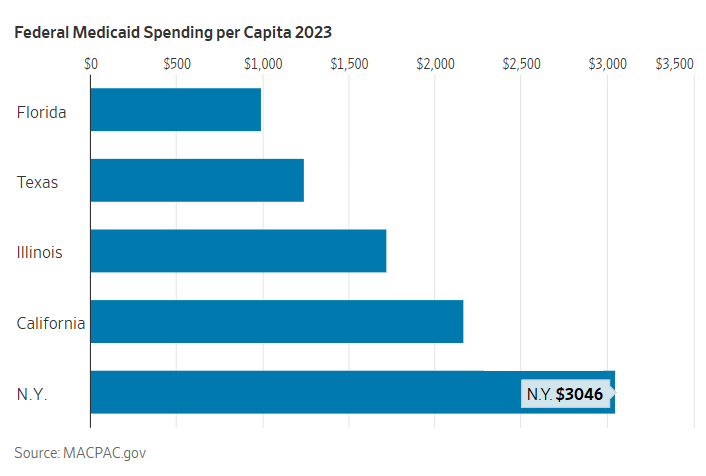
Democratic-run states receive disproportionately more federal Medicaid dollars. New York received $3,046 for each state resident in 2023 based on the most recent federal data. Federal Medicaid dollars also subsidize California ($2,167 per resident) and Illinois ($1,715) much more than Florida ($991) and Texas ($1,239).

Now this one is just silly. Blue states receive more “per resident” because they enacted the ACA Medicaid expansion and thereby enrolled a far larger proportion of their population than the dwindling set of “nonexpansion” states that have chosen instead to keep their uninsured rate at double that of peer expansion states. Kentucky, an expansion state with a population of 4.6 million, drew $13.5 billion in federal Medicaid dollars in 2023 — about $2,800 per resident. Arizona, population 7.6 million, received $18.1 billion in federal Medicaid funding in 2023 — $2,500 per resident, more than New York.

While the 90% FMAP for the ACA expansion population closes the funding gap somewhat between rich states and poor states — the latter have a higher FMAP for all other Medicaid enrollment categories — the rich and blue states don’t receive a disproportionate amount of dollars. Some, notably New York, do have higher per-enrollee costs than the national average —as do some low-income states, including Mississippi.

The table below shows federal dollars per enrollee for the states cited above by the WSJ, along with West Virginia, a low-income state that has expanded Medicaid, and Mississippi, a low-income state that hasn’t. As enrollment was inflated by the pandemic moratorium in 2023, I’ve included totals from October 2024, the last month available, to add perspective. Also shown are the percentage of the state population covered by Medicaid and the state uninsured rate in 2023, the last year available. CHIP enrollment is not included, as MEDPAC does not include CHIP in the spending table on which I’ve built (sources at bottom).

States that have accepted the ACA Medicaid expansion are marked in yellow.

Medicaid Spending and Enrollment in Select States, 2023 and 2024, with Uninsured Rate


Sources:
Federal/state Medicaid spending: MACPAC
Population by state: Census Bureau
Medicaid enrollment (3/23 and 10/24): CMS Monthly Reports
Uninsured rate: KFF

Note that the the percentage of the total population in Medicaid in the expansion states is roughly double that of the nonexpansion states, while the uninsured rate is roughly double in the nonexpansion states. Note also that while spending per enrollee is very low in Florida and very high in New York, it’s not particularly low in Texas (which enrolls so few people that many must be in acute need) or particularly high in California or Illinois. The cost of care varies considerably in different regions of the country, as does the mix of Medicaid enrollees and the benefits offered.

Silly as it is, the WSJ’s per-resident spending measure ignores the fact that Florida and Texas have partially compensated for their refusal to expand Medicaid with rapid enrollment growth at low incomes in the ACA private-plan marketplace. In 2024, Florida, population 23.4 million, had an average of 4 million subsidized marketplace enrollees per month receiving an average premium subsidy of $568 per month, while California, population 39.4 million, had 1.5 million average monthly subsidized enrollees receiving an average of $526 per month. That is, “per resident,” Florida collected about $1,155 in federal subsidies, while California drew about $240.

Cuts are not cuts. The WSJ editorialists claims that the $880 billion Republicans might cut from CBO’s 10-year projections of Medicaid spending is not a cut because spending would grow in absolute dollar terms. That’s just silly. Population grows, inflation is inevitable, and medical inflation usually exceeds overall inflation — though per-enrollee spending growth in Medicaid has been far slower over time than in any other type of U.S. health coverage. Oh, and emergencies such as the COVID-19 pandemic happen — and will all but certainly happen again. Thanks mainly to Medicaid, the uninsured rate barely budged when 20 million people lost their jobs in spring 2020. Per capita caps on the federal contribution, the largest single Medicaid cut on the Republican menu (though disavowed for the moment by Johnson), would strangle the program over time.

While flawed and chronically underfunded, Medicaid is a major contributor to the national welfare. Consider:

  • Medicaid controls costs: From 2008-2023, per-enrollee spending grew by 80.4% in private insurance, 50.3% in Medicare, and 30.3% in Medicaid, according to a KFF analysis of National Health Expenditure data.

  • The federal contribution is higher for low-income than high-income states: in fact, the federal matching rate (FMAP) varies directly according to state per capita income. For FY 2026, FMAPs range from 76.9% for Mississippi to 50% for California, New York and other wealthy states. While wealthy states generally benefit from the 90% FMAP for the ACA Medicaid expansions, so do many low-income states (40 stats plus D.C. have expanded Medicaid to date).

  • The ACA Medicaid expansion cut the uninsured rate nationally by about 40%. From July 2013 to October 2024, Medicaid enrollment increased by almost 23 million. From 2013 to 2023, the national uninsured rate dropped from 14.6% to 7.9%, chiefly as a result of the expansion.

  • Medicaid enrollees are slightly more satisfied with their coverage than enrollees in employer-sponsored insurance, with 82% rating their coverage excellent or good according to a KFF survey.

  • To borrow a timely set of links from Matthew Yglesias: various studies show that Medicaid enrollment has “a meaningful impact on mortality, as well as long-term better economic outcomes for covered kids [see also here] and reductions in crime” — as well as a positive impact on employment among those with disabilities.

Since Trump blithely promised not to cut Medicaid while endorsing the Republican House budget resolution that requires at least $650-880 billion in cuts to the program, Republicans are tuning their guitars to claim that they’re not cutting benefits, only waste and fraud. The Paragon Institute will lead the charge with an array of misleading claims — e.g. that CMS’s accounting of the “improper payment rate” in Medicaid (which is lower than the rate in Medicare) can be construed as a measure of fraud, whereas it mostly flags inadequate documentation. More sophisticated ideological cover for cuts than the WSJ’s are forthcoming. I hope the good scholars at CBPP, the Georgetown Center for Children and Families, and KFF are ready for the onslaught.

Tuesday, September 12, 2023

Two issues for NJ for Health Care Coalition

 Two issues for NJ for Health Care Coalition:

1. Presumed eligible for Medicare? -- An abusive practice in NJ's ACA marketplace


1. AmeriHealth NJ and possibly other insurers in NJ's ACA marketplace are presuming marketplace enrollees over age 65 to be eligible for Medicare unless they prove otherwise by providing a letter from the SSA stating that they are ineligible for Medicare, and why.  An AmeriHealth employee told me that NJ DOBI authorized this presumption, effective in April of this year. Here is what appears to be the rule change in question, albeit in proposed form. The below is from pg. 6 of Proposed Amendments to the NJ's Standard Health Benefit Plans in the individual market, published last fall: 

The Board proposes to remove Medicare from the scope of the Coordination of Benefits Provision and add a provision addressing the effect of Medicare on individual coverage. This new provision clarifies the secondary status of individual benefits when a person is entitled to Medicare as well as addresses the obligation of the consumer to provide information regarding Medicare eligibility. The Benefits from Other Plans provision cross references the newly added provision. 

2. I have not been able to locate a finalization of this rule in NJ's adopted amendments for  individual health coverage or in the NJAC Sect. 11:20 Appendix Exhibits A and B (standard insurance contracts for the IHC)  to which the adopted amendments refer. These documents, as far as I can tell, provide rules for priority of payment if an enrollee in an individual health plan is enrolled in Medicare, but not (as far as I can find) a stipulation that an insurer can presume an enrollee eligible for Medicare unless proven otherwise. But I have seen confirmation, via billing, that Amerihealth is doing this. And it's laid out in Amerihealth's benefits book:


image.png


3. There are almost 9000 over-65 enrollees in NJ's ACA marketplace. It's likely that nearly all of them are legally present noncitizens. If you do not have 10 years' work history in the U.S., you do not qualify for Medicare. The presumption of Medicare eligibility imposes a major administrative burden -- you have to apply for Medicare and submit the subsequent rejection letter. Otherwise, Amerihealth, and likely the other marketplace insurers in NJ, will make only fractional payments to providers for services provided to the enrollee.


4. I put in a journalist's query to CMS (I write a health policy blog) and was told that this practice appears to be illegal:


"In May 2023, CMS issued an FAQ clarifying the benefit coordination between individual health insurance coverage and Medicare. The FAQ clarifies that pursuant to the essential health benefits and actuarial value requirements under the Affordable Care Act, a health insurance issuer offering non-grandfathered individual health insurance coverage may not change the plan payment level or refuse to pay for otherwise covered services on the basis that an individual is eligible for Medicare but not actually enrolled in Medicare. The FAQ is available at https://www.cms.gov/files/document/benefit-coordination-and-medicare-eligibility.pdf.

CMS has been in contact with the New Jersey Department of Banking and Insurance (NJDOBI) regarding this issue.  We recommend contacting NJDOBI for further information."


4. Here is the upshot in the CMS document linked to above:


Q: An individual is enrolled in non-grandfathered individual health insurance coverage and is eligible for Medicare but isn’t enrolled in Medicare. May the issuer change the payment level for or refuse to pay for covered services for which Medicare would have paid had the person been enrolled in Medicare? 


No. In the absence of enrollment in other primary coverage (such as Medicare), an issuer offering non-grandfathered (non-grandmothered)2 individual health insurance coverage cannot take that other coverage into account when paying for covered services. Pursuant to the EHB and AV requirements under the Affordable Care Act,3 an issuer offering non-grandfathered individual health insurance coverage may not limit or exclude coverage based on the theoretical possibility of an individual’s enrollment in other coverage.4 Additionally, modifying a benefit design based on an  individual’s eligibility for Medicare could be considered as violating federal non-discrimination prohibitions. We remind issuers that under regulations implementing the Public Health Service Act’s guaranteed renewability of coverage requirements, Medicare entitlement or enrollment is not a basis to nonrenew an individual’s health insurance coverage in the individual market when the renewal is effectuated under the same policy or contract of insurance.6 5 Therefore, non-grandfathered (non-grandmothered) individual health insurance coverage must pay for covered services for an enrollee who is (or is presumed) eligible for but not enrolled in other primary coverage, without taking that other coverage into account. 


2.  Medicaid Estate Recovery


The current  bill is S3759, introduced in May by Cryan, referred to the Senate Health, Human Services and Senior Citizens Committee.  We would send a similar letter to the one below.


---------- Forwarded message ---------
From: Andrew Sprung <adsprung@gmail.com>
Date: Wed, Apr 7, 2021 at 10:38 AM
Subject: NJ for Health Care meeting request: A1023
To: Downey, Asw. D.O. <AswDowney@njleg.org>
Cc: Maura Collinsgru <maura@njcitizenaction.org>


Dear Assemblywoman Downey: 

Thank you for sponsoring  A1023, limiting the authority of DHS to impose liens and seek recovery from Medicaid recipients' estates after death to enrollees who obtain LTSS, as well as limiting the scope of recovery. On behalf of the NJ for Health Care Coalition, I am writing to request a meeting to discuss plans to get this vital bill enacted. 

At a time when new state and federal resources are being committed to move toward universal health insurance, via both new subsidies and increased outreach and enrollment assistance, it is vital that the promise of affordable insurance not be undercut by hidden consequences for enrollees.   The Coalition believes that Medicaid Estate Recovery from over-55 enrollees who do not receive LTSS services violates the core promise of the ACA to provide "affordable care" to those who seek it.  The 2021 MACPAC report indicates that Medicaid Estate Recovery disproportionately targets less-wealthy enrollees and yields paltry revenue to the states.

The Coalition's commitment to extending access to affordable, quality health care for all New Jerseyans is embodied in our work to advance Cover All Kids legislation, focused on enrolling uninsured New Jersey children in NJ FamilyCare. We regard eliminating the threat of Medicaid Estate Recovery as part and parcel with the effort to extend access, awareness, and trust in NJ FamilyCare to all New Jerseyans who would benefit from enrollment. We trust that you share this goal, and we hope to meet with you at your convenience to discuss how we may best help advance it.  


Dear Senator Cryan: 

Thank you for sponsoring  S3759, limiting the authority of DHS to impose liens and seek recovery from Medicaid recipients' estates after death to enrollees who obtain LTSS, as well as limiting the scope of recovery. On behalf of the NJ for Health Care Coalition, I am writing to request a meeting to discuss plans to get this vital bill enacted. 

At a time when new state and federal resources are being committed to move toward universal health insurance, via both new subsidies and increased outreach and enrollment assistance, it is vital that the promise of affordable insurance not be undercut by hidden consequences for enrollees.   The Coalition believes that Medicaid Estate Recovery from over-55 enrollees who do not receive LTSS services violates the core promise of the ACA to provide "affordable care" to those who seek it.  The 2021 MACPAC report indicates that Medicaid Estate Recovery disproportionately targets less-wealthy enrollees and yields paltry revenue to the states.

The Coalition's commitment to extending access to affordable, quality health care for all New Jerseyans is embodied in our work to advance Cover All Kids legislation, focused on enrolling uninsured New Jersey children in NJ FamilyCare. We regard eliminating the threat of Medicaid Estate Recovery as part and parcel with the effort to extend access, awareness, and trust in NJ FamilyCare to all New Jerseyans who would benefit from enrollment. We trust that you share this goal, and we hope to meet with you at your convenience to discuss how we may best help advance it. 

--
Note to Laura w/ link to nuanced NJ FamilyCare stats, 9/25/23

Laura, re S3759: text of the Bill Statement below. And below that, the count of NJ Medicaid enrollees over age 55: 193,000. Stats here. Only about 10-20k of those would be in long-term care.

This bill amends the law governing the State’s Medicaid estate 35 recovery program and limits the authority of the Division of 36 Medical Assistance and Health Services (DMAHS) in the 37 Department of Human Services to impose a lien and seek recovery 38 from a Medicaid recipient’s estate after death. This bill is designed 39 to allow Medicaid recipients to preserve certain assets and savings 40 for their heirs, while also meeting the minimum federal 41 requirements for the State’s Medicaid estate recovery program 42 pursuant to the “Omnibus Budget Reconciliation Act of 1993,” 43 Pub.L.103-66. 44 Currently, New Jersey’s Medicaid estate recovery program pursues 45 recovery of payments provided through the Medicaid program for all 46 services received on or after the age of 55. Under this bill, the 47 DMAHS would be limited to pursuing recovery for costs associated 48 with nursing facility services, home and community-based services, S3759 CRYAN 4 1 and hospital and prescription drug services provided concurrently 2 with nursing facility or home and community-based services 3 received on or after the age of 55. 4 Additionally, this bill would restrict the definition of “estate” to 5 real and personal property and other assets included in the Medicaid 6 recipient's estate as defined in N.J.S.3B:1-1. In doing so, recovery 7 would be limited to all property and assets that pass from a deceased 8 person to his or her heirs under probate law. Currently, the New 9 Jersey Medicaid estate recovery program utilizes an expanded 10 definition of “estate” which enables DMAHS to also recover from 11 some or all property that bypasses probate, such as life insurance, 12 pension benefits, retirement accounts, and jointly owned real estate 13 and accounts. 14 Finally, the bill makes technical corrections by revising the use of 15 pronouns and removing certain statutory language that no longer 16 applies under current law  

re dual eligiblity:
1. MSP beneficiaries in NJ not subject to estate recovery
https://www.nj.gov/humanservices/dmahs/clients/The_NJ_Medicaid_Program_and_Estate_Recovery_What_You_Should_Know.pdf
2, The morass of dual eligibility, in and out of MSPs
https://www.cms.gov/outreach-and-education/medicare-learning-network-mln/mlnproducts/downloads/medicare_beneficiaries_dual_eligibles_at_a_glance.pdf

Sunday, October 2, 2022

test - AHIP study

 Bob Herman of Stat casts a cold eye on a new claim from AHIP that Medicare Advantage provides superior value to the federal government:

America’s Health Insurance Plans, the industry’s primary lobbying group, funded a new report that was conducted by actuaries at Wakely Consulting Group. AHIP claims the report proves Medicare Advantage...is “saving Americans billions of dollars every year.” The actuaries, however, never use that language in the report.

STAT spoke with several independent Medicare policy experts, all of whom said AHIP’s report was incomplete at best and refuted by other studies that analyzed the same data. 

AHIP's press release asserts that "in 2019, rather than being 2% more expensive than original Medicare, on an apples-to-apples basis, average MA spending was actually about 7% lower than original Medicare."

That conclusion is based on two claims grounded in the Wakely analysis

1) If you were to add an out-of-pocket cost cap to FFS Medicare (as MA provides), the per-person cost would increase 3.5%.

2) "Apples to apples" requires excluding from the FFS cost calculation those enrollees who are enrolled only in Part A or only in Part B*, rather than in both. Single-part enrollees in Part A in particular spend significantly less in Part A than enrollees in both parts. The Wakely report asserts in the executive summary, "Costs associated with non-ESRD** FFS beneficiaries who are enrolled in both Parts A and B are about 5.9% higher than the total non-ESRD FFS population."

The first claim is not exactly "apples to apples," but it makes a fair point. An OOP cap is valuable, it's included in MA plans, it's not included in FFS Medicare, and if it were, current costs might be comparable. More on that below.

The second claim looks erroneous to me, and implicitly contradicted in the rather brief analysis section of the Wakely report. Excluding single-part Medicare enrollees from the per-person FFS cost calculation would not result in a 5.9% increase in the estimated cost. 

To calculate the per-person cost of FFS Medicare, MedPAC includes all FFS enrollees, including those enrolled only in Part A or only in Part B. MedPAC acknowledges that if enrollees who have only Part A or Part B were excluded, the per-person FFS cost estimate would be about 1% higher, as single-part enrollees (in Part A in particular) tend have lower per-person costs (see notes to Figure 12-3, p. 431 in the 2022 report). 

As of 2019 (the year on which the Wakely calculations are based), about 16% of 39 million FFS Medicare enrollees were enrolled only in Part A (5.1 million) or only in Part B (1.3 million).  Since MA enrollees by definition are enrolled in both Part A and Part B, AHIP argues that excluding single-part FFS enrollees creates an apples-to-apples comparison..

 Wakely's estimate of the effect of including single-part enrollees in the per-person cost calculation depends on its estimate that spending on Part A for enrollees enrolled in both A and B is 13.4% higher than Part A spending for Part A-only enrollees. Part B is a wash:

Wakely independently calculated the cost difference with the 2019 100% FFS data. We found that Part A spending was 13.4% higher for beneficiaries that were enrolled in Part A and B compared to those only enrolled in Part A. This compares to the 8% in MedPAC’s study. We believe one cause of the cost differential increasing is that MA penetration has been increasing over time, leaving fewer beneficiaries in FFS. Since beneficiaries must be eligible for both Part A and B, those with Part A only enrollment comprise a greater percentage of the total remaining in FFS. 

For Part B spend, we also found there was no material difference between the two populations. Combining the impact based on overall cost, the total non-ESRD FFS spend is 5.9% higher for those enrolled in Part A and Part B vs those enrolled in Part A and/or Part B.  

That last term in the comparison, "those enrolled in Part A and/or Part B" is an odd way of saying "all enrollees" -- but that is what it means. Yet the contrasts outlined above are between those enrolled in both Parts A and B vs. those enrolled in only one part. And only the contrast with those enrolled in Part A only appears to matter. 

About 13% of FFS enrollees are in Part A only, and (coincidentally), Wakely finds that their Part A costs are 13% higher than those of Part A/B enrollees. That suggests that the Part A cost estimate would be about 1.5% higher if those enrolled in Part A only were excluded. 

Part A accounts for about 48%  of the combined costs of Parts A and B (as of 2018).  Thus it seems to me that Wakely's estimate of the effect of excluding single-part enrollees from the cost calculation should be pretty close to MedPAC's -- raising the estimate by about 0.75% (vs. MedPAC's 1%). But that's not what's claimed in the executive summary -- or, in more circumlocutory fashion, in the analysis above.

AHIP takes the claim in the executive summary  and runs with it, proclaiming that in an "apples-to-apples" comparison, MA costs 9.4% less per person than MedPAC's 2019 estimate for FFS, and 7% less than FFS net.  Three quarters of that difference from MedPAC estimates is derived from the alleged effect of removing the single-part FFS enrollees from the FFS cost estimate. Most of that effect appears questionable. It's six times higher than MedPAC and FFS estimates.

What about the first, more modest claim -- that if FFS Medicare had an OOP cap, costs would be 3.5% higher? Adding the hypothetical cap would all but zero out MedPAC's 2022estimate that MA costs 104% of what the federal government would pay if all MA enrollees were in FFS Medicare. 

“That’s sort of a different point than when you look at actual spending,” Jeannie Fuglesten Biniek, a senior Medicare analyst at KFF, told Stat's Herman. “We’re still paying Medicare Advantage plans more. Maybe you’re getting more for it, but that’s a different question.”

That "different question" is worth asking. If MA costs 104% of the cost of FFS per person, and that extra 4% includes an OOP cap and, in total, $2,000 worth of average extra benefits by MedPAC 's estimate, MA does have a fair claim to offer savings to the federal government. The question is, should the federal government be incentivizing enrollees to opt for those extra benefits in exchange for a limited network, prior authorization, and higher risk of coverage denials constitutes a legitimate source of savings.

Put another way, would the extra money the federal government lavishes on MA would be better spent improving benefits in FFS, thereby reducing MA's growing funding advantage?  On this front, AHIP has in a sense undercut its own argument. MedPAC argues annually that the payment formulas for MA are on various fronts too generous, and that the efficiencies MA does attain (spending about 85% per member of what FFS Medicare spends) should be constrained within payment at par. If that were were achieved, the extra 4% paid to MA plans (or 3%, by KFF's estimate***) could fund the FFS OOP cap, according to Wakely's calculations. That in turn would negate a key advantage held by Medicare Advantage.

----

Thursday, March 31, 2022

Hail Mary: Should Democrats Trade silver loading for ARPA subsidy extension?

The increases to premium subsidies in the ACA marketplace provided through 2022 by the American Rescue Plan Act (ARPA) have been a policy success, helping to boost marketplace enrollment by 21% this year.

The subsidy boosts -- benchmark silver plans free to enrollees with incomes up to 150% FPL, premiums reduced at all income levels and capped at 8.5% of income for those with income over 400% FPL -- went a long way toward establishing an ACA worthy of its name. The revised subsidy structure, paired with Medicaid expansion in the 38 states (plus D.C) that have enacted the expansion, is at least in range of offering affordable coverage to all who lack access to other affordable insurance.

During Democrats' long, weary negotiations over the Build Back Better bill in the fall, the extension of those subsidies was taken as a given. A party in power can't roll back an unqualified policy success. It was worrisome when the subsidy extension in the last BBB iteration was reduced from permanent to three years (through 2025), as Republicans are likely to a) control at least one house of Congress and b) let the enhanced subsidies expire. But letting the ARPA subsidies expire in advance of enrollment for 2023 seemed unthinkable.

Now, suddenly, it's thinkable. Insurers will soon be preparing their rate proposals for 2023.  Manchin keeps dismissing the revival of anything closely resembling the BBB bill.  Anxiety among ACA watchers is spiking. The ARPA subsidy boosts are at risk.

As Democrats' legislative hunger games devolve into starvation games -- a struggle to get a few scraps of BBB into lean legislative sausages -- one floated proposal is to fund the ARPA-level subsidies by funding the marketplace's Cost Sharing Reduction (CSR) subsidies in the original, statutory way, directly reimbursing insurers for their CSR costs. That would end silver loading -- the pricing of the value of CSR directly into silver plan premiums (since CSR is available only with silver plans), which has created sometimes-dramatic discounts in bronze and gold plans, as premium subsidies are set to a silver benchmark (enrollees pay a fixed percentage of income for the second cheapest silver plan) and rise when silver premiums rise. Silver loading began in 2018, after Trump cut off direct CSR reimbursement in October 2017.

Silver loading made free bronze plans widely available at incomes up to 200% FPL* and often beyond (the discounts increase with age, as premium subsidies rise to cover premiums that rise with age, and spreads between the benchmark silver plan and cheaper plans increase as well). In some regions and whole states, gold plans are available with premiums below that of the benchmark silver plan. That's because most enrollees in silver plans have incomes below 200% FPL, and below that threshold CSR raises the value of a  silver plan to roughly platinum levels. Thus, silver plans have higher actuarial values on average than gold plans.  Five states, with behemoth Texas to follow, have effectively required insurers to price gold plans near or below silver plans.

In a post-ARPA market with strict silver loading, enrollees with incomes below 200% FPL can get CSR-enhanced, high-AV silver plans for free or cheaply (topping out at 2% of income for benchmark silver at 200% FPL), and enrollees with incomes over 200% FPL can get gold plans (80% AV) at or below a premium deemed affordable by ACA standards, i.e., below the cost of benchmark silver (between zero and 8.5% of income).

Silver loading is expensive. In August 2017 the Congressional Budget Office, anticipating Trump's cutoff of direct CSR reimbursement, forecast a 10-year cost of $194 million.  In October 2021, CBO estimated the cost of permanently extending the ARPA subsidies (as the Sept. 15 iteration of the Build Back Better bill would have done) at $209.5 billion.

Those estimates are four years apart, and silver loading has not worked out quite as CBO (following prior analysis by the Urban Institute and HHS) anticipated, in that gold plans have not been consistently priced below silver. Silver plans remain broadly underpriced relative to bronze and gold (given the average AV obtained by silver plan enrollees, a large majority of whom obtain the strong CSR available below 200% FPL). Analysts including Stan Dorn of Families USA attribute the misalignment in part to CMS's risk adjustment formula, which allegedly favors silver plans. The average benchmark silver plan premium in 2022 is 9% below the average in 2018, when silver loading began, rendering the premise that silver loading would increase premium subsidies by an average of almost $20 billion per year over ten years somewhat counterintuitive.   Nonetheless, Brookings' Matt Fiedler, comparing metal level pricing since 2017 to the pre-2018 trend, estimates that through 2021, silver loading had raised silver plan premiums (and so, federal subsidy costs) by 25%.

Those complexities and uncertainties notwithstanding, it's fair to say that the savings from ending silver loading (funding CSR) are in the ballpark for offsetting the 10-year cost of making the ARPA subsidies permanent. What about the merits?

The Build Back Better bills would have "paid for" ARPA subsidy extension by other means. But the last iteration, constrained by the perceived demands of Manchin and Sinema, would have only extended the subsidies through 2025, at a cost estimated by CBO at $73.9 billion. Manchin reportedly demanded that BBB's myriad of programs funded only short-term be replaced with a smaller group of priorities funded permanently. If ARPA subsidies make the cut, permanently funded,  all good. 

If, however, a choice boils down to funding the enhanced subsidies for three years (or two, or four..), or funding CSR reimbursement and making the ARPA subsidies permanent, I'd have to say that the permanent boost would be worth the price of giving up silver loading.

I have what you might call an emotional investment in silver loading, developed through anticipating it, describing it at the emergency outset, tracking its effects on enrollmentadvocating for its intensification, worrying about its pre-ARPA side effects, and tracking the results of state initiatives. Paired with ARPA, and if maximized by regulation, it guarantees that everyone eligible for marketplace coverage has access to at least one health plan with an actuarial value of at least 80% (or, at lower incomes, 87% or 94%) at a cost at or below the benchmark premium. Making 80% AV coverage affordable at incomes over 200% FPL completes the ACA's "affordable care" equation.

That said, the ARPA subsidy boosts provided a more sweeping and fundamental reboot of the marketplace than silver loading did. Silver loading probably boosted marketplace enrollment by about 5%; the ARPA subsidies, by 21%.  Moreover, the value of large increase in free bronze plans at low incomes generated by silver loading has been largely eclipsed by ARPA's major boost to the affordability of benchmark silver enhanced by strong CSR (free to 150% FPL, 2% of income at 200% FPL) at low incomes.  Silver loading does, however, create strong value for enrollees with incomes over 200% FPL, especially in markets where gold plans are available below benchmark.

-----

* Free bronze plans at low incomes are something of a mixed blessing, as bronze plan deductibles average about $7,000, while silver plan deductibles average less than $200 at incomes up to 150% FPL and around $800 at incomes in the 150-200% FPL range. In the silver loading era, silver plan selection at incomes up to 200% FPL dropped from 87% in 2017 to 78% in 2021. The ARPA subsidies appear to have reversed that slide, at least in the emergency Special Enrollment Period that ran from Feb. 15 to Aug. 15 in 2021, with ARPA coming into effect in March and ARPA premiums posting in April.

CBO Oct 19
https://www.healthaffairs.org/do/10.1377/forefront.20211021.257493
https://energycommerce.house.gov/sites/democrats.energycommerce.house.gov/files/documents/Letter_Honorable_Jason_Smith.pdf

Tuesday, June 4, 2019

ACA marketplace plans in New Jersey: Services not subject to deductible at different metal levels

ACA Marketplace options: North Brunswick (Middlesex County), zip code 08116, single 40 year old

Income $60,000  (no subsidies)

Bronze: 5 plans, premium range $279-$440 per month.  All bronze plans have $3,000 individual deductibles.  No services before deductible with the exception of the most expensive bronze plan, Horizon OMNIA at $440/month, which has primary care doctor visits at $30 each, not subject to deductible. This plan also has the highest out-of-pocket (OOP) max. OOP maxes ranges from $6750 to max allowable $7900 (OMNIA).

Silver: 11 plans, premium range $342-764/month. 7 have services not subject to deductible; 3 are HSAs.  Deductibles range from $1500-2500; OOP maxes range from $5000 (HSA plan) to $7500.

Gold: 5 plans, premium range $538-800/month. Deductible range $1000-2500. All have services not subject to deductible. OOP max range $2500-6000.

Income $30,000 (lowest level CSR)

Showing silver plans only -- other metal level benefits don't differ by income
40 year old

11 plans, premium range $200-623/month, deductible range $1200-2500.  7 plans with services before deductible; 3 HSAs. Oop max range $4500-6300.


Bronze plans at $60,000 income (no subsidy)


Silver plans at $60,000 income (no subsidy). Showing first 9 of 11 (ranked by premium)


Gold plans - income $60,000 (no subsidy)


Silver plans - income $30,000 (lowest level CSR, 73% AV). Showing 9 of 11 


A note on variations by county: While all rating areas in NJ have the same premiums for each plan, not all rating areas have all plans offered in the state, which led to variations in price spreads. Middlesex county, showed here, had the dominant pattern, available in most of the state. The map below, from a Kaiser Family Foundation tool that shows prices by county at each metal level and different income levels, shows where NJ offers varied; click through to the tool to see the counties named.


Friday, January 19, 2018

Mr. Macho


Mr. Macho below.